In sub-Saharan Africa, home to about seven in ten of the world's maternal deaths, referral hospitals are meant to be the safety net for severe obstetric emergencies. How many maternal deaths, complications and stillbirths happen in urban referral hospitals at three different levels?
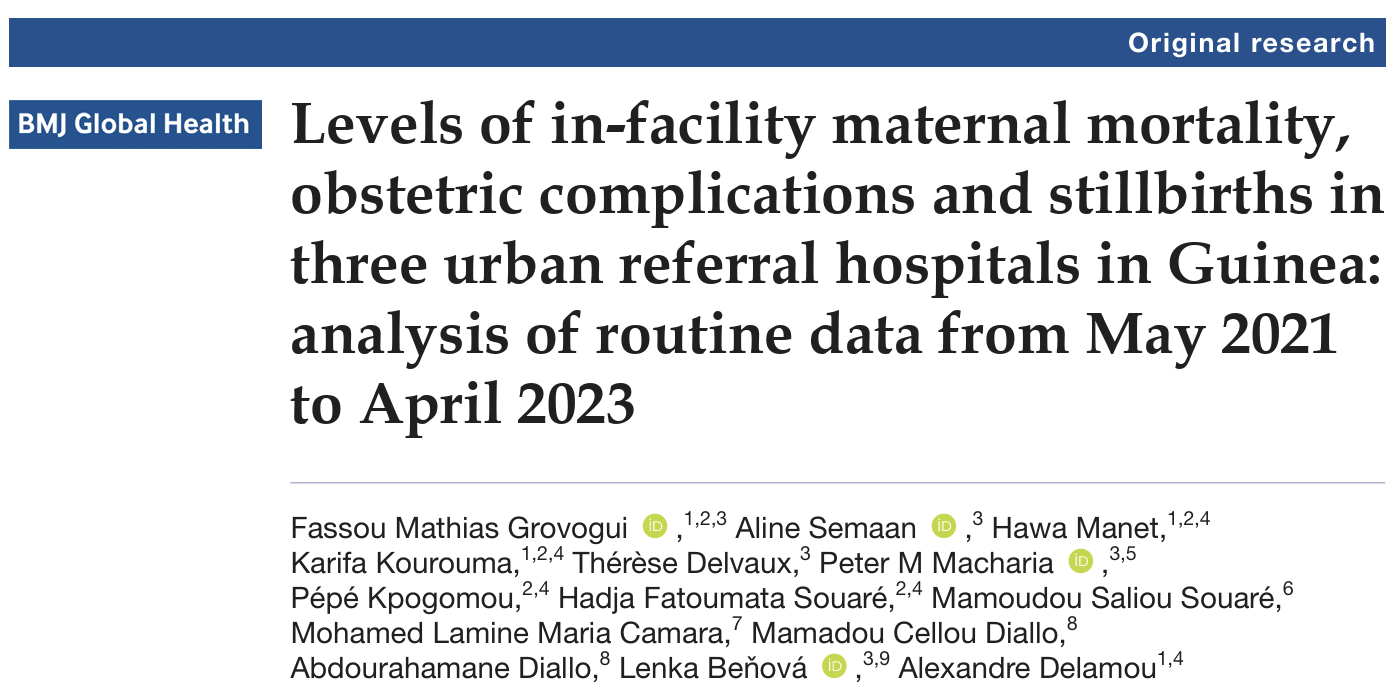
A new study in BMJ Global Health, led by Dr Fassou Mathias Grovogui, analysed routine data on 25,235 women admitted to three urban referral hospitals in Guinea — district (Forécariah), regional (Mamou) and national (Ignace Deen, Conakry) — from May 2021 to April 2023.
In-facility maternal mortality peaked at the national hospital — 1,264 deaths per 100,000 live births — with postpartum haemorrhage the leading cause. Complications affected one in four women at the district and regional hospitals, and two in five in the national hospital. Stillbirth rates reached 77–103 per 1,000 births, around half being fresh stillbirths.
In this short video, we summarise the reflections on the findings of this study by Dr Facely Camara in Guinea, and the implications for the health system.
Three in ten women at the national hospital had no documented complications — likely routine births.
In a tertiary referral facility, that raises hard questions about maternity care elsewhere in Conakry.
Behind the numbers the study team identified critical issues including delays in reaching and receiving care, weak referral and transport, cities where traffic is a barrier to accessing life-saving care, and a data crisis — nearly one in three women in the Ignace Deen hospital had no individual patient record.
The authors call for stronger emergency obstetric care at lower levels, better transport and referral, and community awareness of danger signs.
When the national referral hospital sits in a congested capital, centralisation itself can cost lives.
The authors urge policymakers to rethink the hierarchy —moving some specialist services to secondary facilities to cut travel time and traffic congestion.
The full paper is available here: https://gh.bmj.com/content/11/5/e020317
En Afrique subsaharienne, qui concentre environ sept décès maternels sur dix dans le monde, les hôpitaux de référence sont censés constituer le filet de sécurité face aux urgences obstétricales graves. Combien de décès maternels, de complications et de mort-nés surviennent dans les hôpitaux de référence urbains de trois niveaux différents ?
Une nouvelle étude publiée dans BMJ Global Health, menée par Dr Fassou Mathias Grovogui et collaborateurs, a analysé les données de routine de 25 235 femmes admises dans trois hôpitaux urbains de référence en Guinée — district (Forécariah), régional (Mamou) et national (Ignace Deen, Conakry) — de mai 2021 à avril 2023.
La mortalité maternelle intra-hospitalière culminait à l'hôpital national (1 264 décès pour 100 000 naissances vivantes), l'hémorragie du post-partum en étant la première cause. Les complications touchaient une femme sur quatre dans les hôpitaux de district et régional, et deux sur cinq au niveau de l’hôpital national. Les taux de mortinatalité atteignaient 77 à 103 pour 1 000 naissances, avec 40 à 50 % de mort-nés frais.
Dans cette courte vidéo, nous résumons les réflexions sur les conclusions de cette étude menée par le Dr Facely Camara en Guinée, et leurs implications pour le système de santé.
Trois femmes sur dix admises à l'hôpital national ne présentaient aucune complication documentée — probablement des accouchements eutociques. Pourquoi les femmes qui ne présentent pas de complications choisissent-elles d'accoucher dans des hôpitaux de référence ? Cela soulève des questions difficiles concernant les soins de maternité dispensés dans d'autres établissements de Conakry.
Derrière les chiffres : des retards pour atteindre et recevoir les soins, des systèmes de référence et de transport fragiles, une capitale engorgée où la circulation devient un obstacle, et une crise des données — près d'une femme sur trois à l'hôpital national n'avait aucun dossier individuel.
Les auteurs appellent à renforcer les soins obstétricaux d'urgence aux niveaux périphériques, à améliorer le transport et la référence, et à sensibiliser les communautés aux signes de danger.
Lorsque l'hôpital national de référence se trouve au cœur d'une capitale engorgée, la centralisation elle-même peut coûter des vies. Les auteurs invitent les décideurs à repenser la hiérarchie — en rapprochant certains services spécialisés de structures secondaires pour réduire les temps de trajet et le congestionnement.
L'article complet est disponible ici: https://gh.bmj.com/content/11/5/e020317