By Dr Catherine Birabwa
“In most cases, we care for others, and we forget about those caring for them”.
A Senior Nursing Officer made this statement in an interview, raising concern over the limited attention given to the well-being of maternal and newborn healthcare workers.
Status quo
At the core of maternal survival, health, and wellbeing are healthcare workers, responsible for providing life-saving interventions. Oftentimes, health workers strive to provide standard care to women despite multiple constraints, sometimes at the expense of their own well-being.
Conventionally, much emphasis is put on issues such as functional roles, competency, performance outcomes, human resource management practices and regulation, with limited attention on the “humanness of health workers”, which includes their motivation. Improving health worker well-being and motivation requires strategies informed by a deeper understanding of their behaviours, while continuing to improve their work environment and other external influences.
Our study
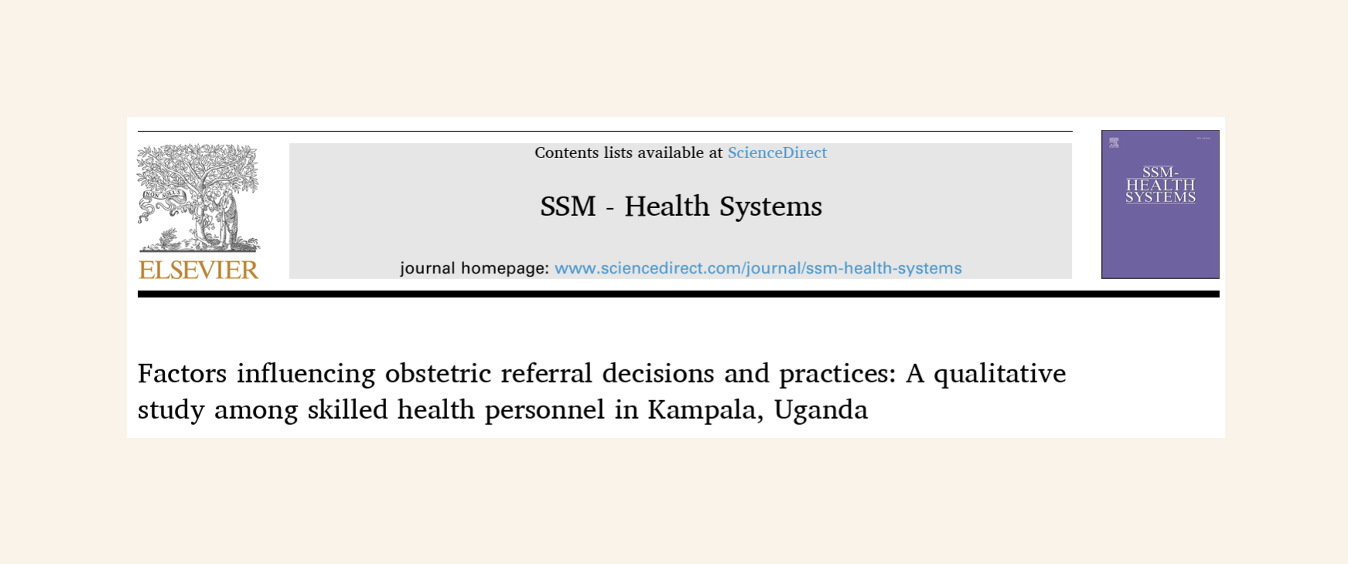
In this context, our recently published article presents findings from a study that sought to better understand behaviours of healthcare workers by exploring processes and experiences related to obstetric referrals in Kampala City, Uganda. Drawing on the Capability, Opportunity, Motivation and Behaviour Model and narratives from 45 maternal and newborn healthcare workers, the study underscored persistent work-environment barriers that limit appropriate referral practices. In particular, findings highlighted challenges during the patient handover process that potentially demotivated healthcare workers and contributed to suboptimal referral practices.
Participants described the handover process as unnecessarily lengthy and burdensome for the accompanying healthcare worker, while the support provided during this process was often inadequate, if any. Many also reported experiences of disrespect, unjust criticism, and an unwelcoming reception from colleagues at receiving facilities. These experiences contributed to feelings of fear, frustration and discouragement, and ultimately, suboptimal referral practices.
“Sometimes when you reach the referring place, people do not receive you, you have to go and prepare for the patient yourself. You have to go get a bed for the patient yourself; you have to figure it out yourself.”
Senior Midwife, Private medical centre
“Before she [receiving staff] even reads the referral note, she is already shouting at you, but she has not even read the interventions we have done. We are asking ourselves - Should we refer these mothers without doing anything before they look at it as an emergency?"
Midwife, Health Centre
Implications
The findings suggested that behavioural and psychological factors may play a key role in shaping the behaviours of maternal and newborn healthcare workers during referrals. Further exploration of these factors could deepen our understanding of the dynamics and related decision-making that healthcare workers navigate as they provide necessary care, helping to inform strategies that better support them in their functional roles. This may be complemented by sociological research examining how professional norms and collaboration across healthcare institutions, including emergency medical services systems, can be strengthened to improve maternal and newborn care delivery.
The full article is published in the journal Social Science and Medicine - Health Systems and can be found here.
For more information, contact cbirabwa@musph.ac.ug.